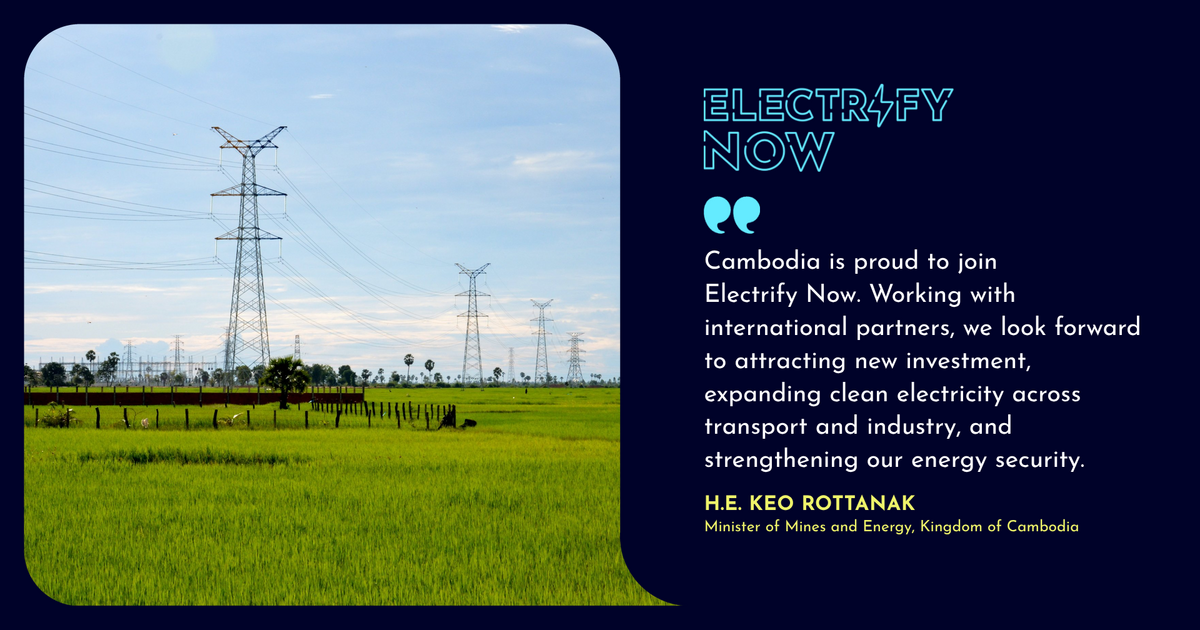
Cambodia has joined Electrify Now, an international initiative to accelerate clean electrification and address the economic and energy security risks of dependence on fossil fuels.
Cambodia joins a government coalition coordinated by the European Commission, alongside countries including Australia, Brazil, Canada, Germany, the Philippines, the Republic of Korea, Singapore, Türkiye (the COP31 host) and the United Kingdom.
The initiative promotes greater use of clean electricity across transport, industry and buildings, supported by investment in power generation, electricity networks and storage, alongside efforts to strengthen supply-chain resilience. For Cambodia, replacing imported fuels with efficient electric technologies powered by domestic clean energy can reduce exposure to international fuel-price shocks and improve energy efficiency.
“Cambodia’s investment in clean power is central to our commitment to environmental stewardship and helps strengthen energy security and economic competitiveness,” said H.E. Keo Rottanak, Minister of Mines and Energy. “We are expanding electricity use across transport and industry, supported by reliable networks and storage. Through Electrify Now, we will build on these efforts with international partners to address practical barriers and mobilise investment.”
Participation in Electrify Now provides a platform to exchange policy and technical experience, strengthen electrification planning and cooperate on the infrastructure and financing needed for implementation. The initiative also brings together businesses and civil society to identify deployment barriers and advance practical solutions.
Cambodia joined Electrify Now ahead of COP31, which is taking place in Antalya, Türkiye, from 9 to 20 November 2026. Electrify Now supports the global ambition to increase electricity’s share of final energy consumption to 35% by 2035, complementing international efforts to expand renewable energy and improve energy efficiency. Countries will pursue this collective ambition according to their national circumstances and development priorities.
ត្រលប់ទៅព័ត៌មានទាំងអស់